Advanced processing for UHR3D shallow marine seismic surveys

Authors: H. Duarte, N. Wardell and O. Monrigal

ABSTRACT

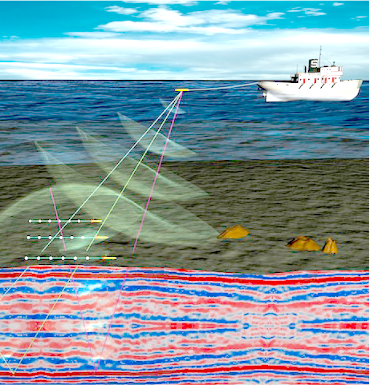
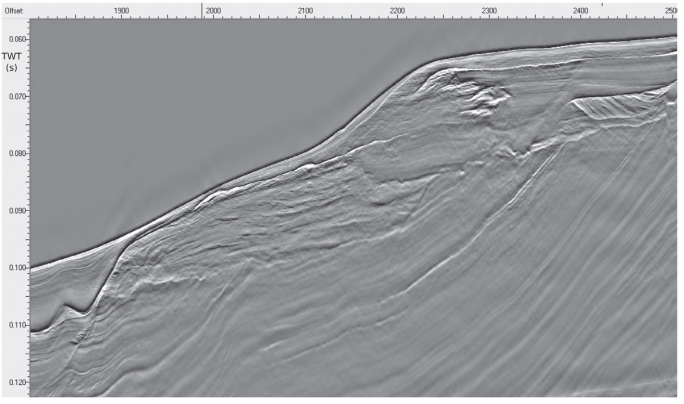
Traditionally, commercial ultra-high-resolution 3D multichannel seismic surveys have used sources with relatively low-frequency content (up to 600 Hz) with corresponding relatively low resolution. The new generation of multi-tip sparkers, however, utilising negative discharge technology, is able to produce repeatable high-frequency signals (above 2.5 kHz) with the potential to image hundreds of metres of the shallow stratigraphy at < 50 cm vertical resolution. These sources would be especially suited to ultra-high-resolution 3D studies such as the foundations of wind turbines installations for offshore wind farms.

However, simple downsizing of conventional processing sequences, designed for sources of significantly lower frequency content, is not enough. To preserve the signal properties of the sparker source and produce accurately positioned seismic images, new strategies are needed. The implementation of processing solutions that accurately determine source and receiver depths for all shots is also paramount to correctly reduce the data to the desired vertical datum.

A basic methodology for deriving geometry and shot corrections for wave motion and tides from the 3D data themselves has already been demonstrated. With Differential Global Positioning System (DGPS) navigation available on both source and streamers and the correct integration of the seismic recording and positioning systems, this concept has been further developed and refined to be more precise. Being able to derive components of the streamer position and depth is of great importance for effective broadband processing from the slanting streamers that are deployed in acquisition. New procedures and processing techniques have been developed, and their efficacy is demonstrated on case studies of recently acquired 2D and 3D multichannel data.

Link:
https://doi.org/10.3997/1873-0604.2017022

LET'S TALK ABOUT Advanced processing for UHR3D shallow marine seismic surveys

In GeoSurveys we have solutions and inovation for our clients


    ARTICLES

    Defining the Future of Marine Seismic Imaging

    READ ALL
    Avo Inversion and Processing of Ultra-High Resolution Seismic for a Windfarm Application

    Avo Inversion and Processing of Ultra-High Resolution Seismic for a Windfarm Application

    Authors: K.H. Karkov, E. Dalgaard, A.T. Diaz, H. Duarte, H.J. Hansen, S. Hviid, N.C. Høegh van Gilse, L. Krogh, S. Kuppens, G. Salaün and F. Correia Summary The development of offshore windfarms has increased worldwide. A thorough understanding of the subsurface geotechnical conditions for foundation design and installation is still more important as turbines are […]

    Read More from Avo Inversion and Processing of Ultra-High Resolution Seismic for a Windfarm Application

    Navigation, Guidance and Control of Underwater Vehicles within the Widely scalable Mobile Underwater Sonar Technology (WiMUST)

    Navigation, Guidance and Control of Underwater Vehicles within the Widely scalable Mobile Underwater Sonar Technology (WiMUST)

    Authors: H. Al-Khatib, G. Antonelli, A. Caffaz, A. Caiti, G. Casalino, I.de Jong, H. Duarte, G. Indiveri, S. Jesus, K. Kebkal, A. Pascoal and D. Polani,  Abstract The WiMUST (Widely scalable Mobile Underwater Sonar Technology) project aims at expanding and improving the functionalities of current cooperative marine robotic systems, effectively enabling distributed acoustic array technologies […]

    Read More from Navigation, Guidance and Control of Underwater Vehicles within the Widely scalable Mobile Underwater Sonar Technology (WiMUST)

    An ultra-high-resolution 3D marine seismic system for detailed site investigation

    An ultra-high-resolution 3D marine seismic system for detailed site investigation

    Authors: O. Monrigal, I. de Jong and H. Duarte ABSTRACT Currently, marine ultra-high-resolution 3D surveys tend to be characterized by signal frequency ranges of 0–600 Hz and bin sizes of the order of 3 to 6 metres. This may be acceptable in industry geohazard studies for top-hole well drilling, but it does not have sufficient […]

    Read More from An ultra-high-resolution 3D marine seismic system for detailed site investigation

    Advanced processing for UHR3D shallow marine seismic surveys

    Advanced processing for UHR3D shallow marine seismic surveys

    Authors: H. Duarte, N. Wardell and O. Monrigal ABSTRACT Traditionally, commercial ultra-high-resolution 3D multichannel seismic surveys have used sources with relatively low-frequency content (up to 600 Hz) with corresponding relatively low resolution. The new generation of multi-tip sparkers, however, utilising negative discharge technology, is able to produce repeatable high-frequency signals (above 2.5 kHz) with the […]

    Read More from Advanced processing for UHR3D shallow marine seismic surveys

    CLIENTS AND PARTNERS

    We work with the best clients

    Thumbnail of
    Thumbnail of
    Thumbnail of
    Thumbnail of
    Thumbnail of
    Thumbnail of
    Thumbnail of
    Thumbnail of